

If you care deeply about a partner who has not said “I love you,” the uncertainty can hurt. You may wonder whether he needs time, finds the words difficult or does not feel the same way. His silence alone cannot tell you which explanation is right.
You can be considerate about his feelings while taking your own needs seriously. A useful next step is to ask what the relationship means to each of you, listen to the answer and decide whether the connection works for you as it is.
In this article

1. Separate what you know from what you imagine
You know that you have not heard the words. You might also know how often you see each other, which plans you have made and what he has said about the relationship. Those observations are different from a conclusion such as “He must be afraid of love” or “He is only passing time with me.”
There may be several possible explanations, but choosing the most comforting or most painful one does not make it true. You do not need to diagnose his past, guess his attachment style or interpret every gesture before you can ask a direct question.
Try writing two short lists: what he has actually said or done, and what you are assuming it means. Use the first list to explain your concern. Leave room for him to describe his own feelings rather than presenting your theory as a fact.
2. Clarify what the words mean to you
Consider what you hope to hear when he says “I love you.” Is it affection, reassurance, exclusivity, a shared future or recognition that the relationship matters? These wishes may overlap, but they are not interchangeable agreements.
For example, “I want to know whether we are dating exclusively” calls for a conversation about exclusivity. “I would like to hear affection expressed in words” describes a preference for verbal reassurance. Asking the specific question may give you more useful information than waiting for one phrase to settle everything.
You are allowed to value spoken affection. He is allowed to be honest about his feelings. A conversation can respect both positions without requiring either person to pretend that the difference does not matter.
3. Look at the relationship you actually have
Notice how you treat each other in ordinary life. Can you make workable plans, raise a concern and say no? Is interest and effort mutual? Do the agreements you have made match what happens? A single busy week or awkward exchange cannot answer every question, so consider the wider pattern and its context.
You do not need to decide who should say the words first as a test of courage or maturity. If you want to share your feelings, you can do so. If you are not ready, you can ask about the relationship without making a declaration yourself. Neither approach guarantees the response you hope for.
Kind actions can matter without proving that he privately feels love. Equally, a declaration does not cancel repeated disrespect or broken agreements. Pay attention to both what is said and how the relationship affects your daily life.
If you are parenting, keep decisions about introducing a partner to children separate from a wish for reassurance. You do not need to change family routines or share children’s private information to demonstrate how serious you are.
4. Start an honest conversation without a test
Choose a moment when you both have room to talk. You might say: “I care about you, and I have noticed we have not talked much about our feelings. I would like to understand how you see this relationship.” Ask, then give him space to answer.
If verbal affection is important, explain that directly: “Hearing how you feel matters to me. I do not want you to say something you do not mean.” This communicates a need without supplying the answer he is expected to repeat.
You can share your feelings without bargaining for a matching declaration: “I love you. You do not have to say it back to reassure me, but I would like an honest conversation about where we stand.” Only use words that reflect what you actually feel.
The NHS guide to healthy relationships suggests open conversation and listening to check that you understand. You could ask, “When you say you are unsure, do you mean your feelings, the kind of relationship you want, or something else?” A clearer answer is more useful than pressing for a particular phrase.
5. Listen to uncertainty without promising to wait forever
He may say that he cares but is unsure about love, that he wants a different arrangement, or that he does not want the relationship to progress. Take those answers seriously. Repeatedly offering a more hopeful interpretation can leave you responding to a future he has not offered.
If he describes past hurt, you can listen with care. You are not required to prove that you are different from an ex, accept harmful behaviour or become responsible for changing his feelings. A difficult history does not tell you how long uncertainty will last.
If you both want to continue, agree on what that means now. You might discuss the contact you want, existing commitments and when to revisit the conversation. A review point is an opportunity to speak again, not a deadline by which someone must fall in love.
6. Choose what meets your needs
Ask whether you want this relationship under its current conditions. You might be comfortable continuing to get to know each other, need a clearer agreement or decide that the difference is too painful. You do not have to prove that he is a bad person to choose to leave.
Try describing your decision through what you will do: “I respect that you are unsure. I am looking for a relationship with mutual commitment, and I do not want to continue on these terms.” A boundary guides your participation; it is not a technique for producing a declaration.
If raising the subject brings threats, coercion or fear of retaliation, seek individual support from a domestic abuse service before deciding how to communicate a change. You do not owe a private confrontation. For ordinary uncertainty, a trusted friend can offer perspective while leaving the decision with you.
You may feel disappointed even when the answer is clear. Give yourself room to respond, and choose a next step that respects both his freedom to be honest and your freedom to want something different.
Read the infographic in text
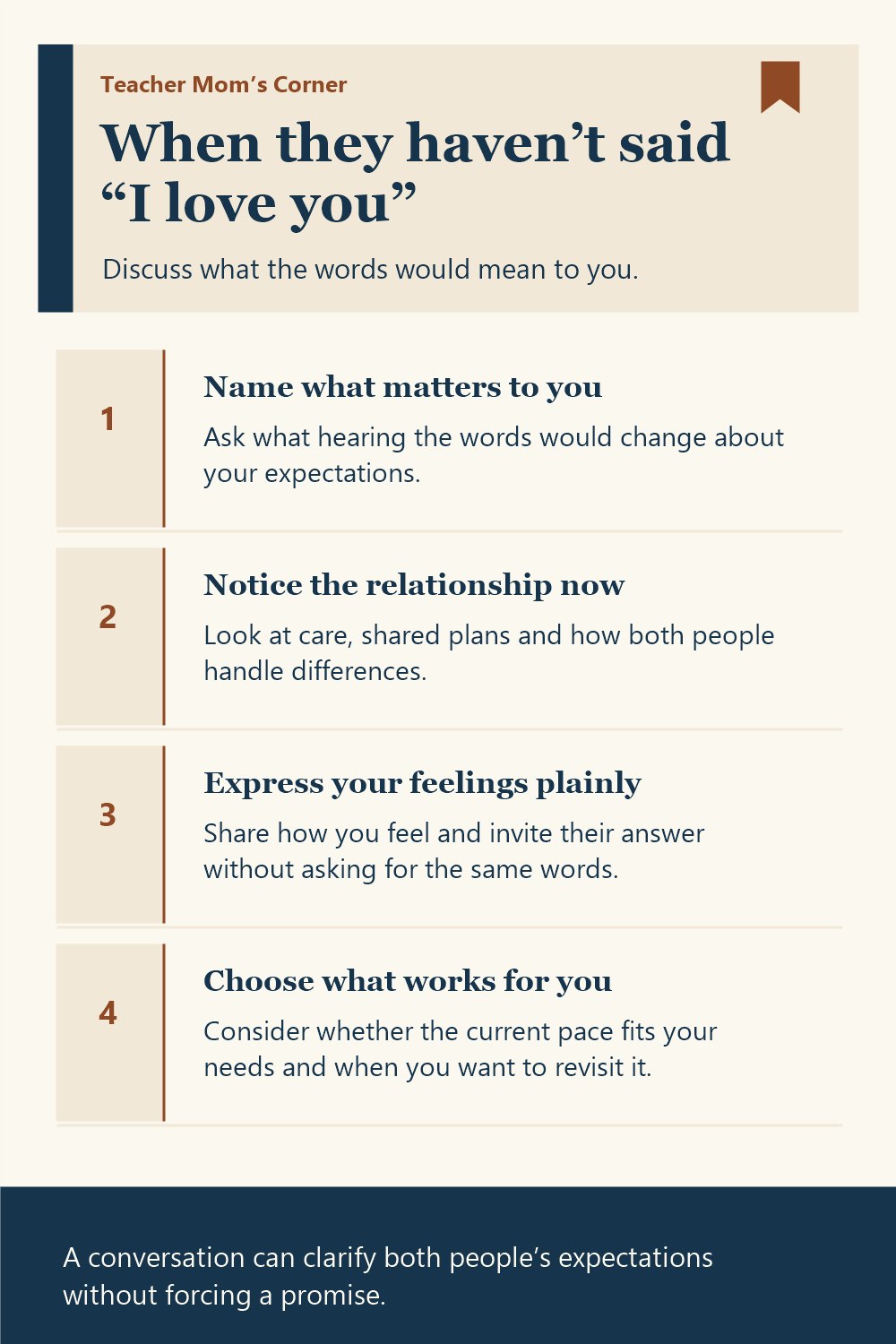
When they haven’t said “I love you”
Discuss what the words would mean to you.
- Name what matters to you Ask what hearing the words would change about your expectations.
- Notice the relationship now Look at care, shared plans and how both people handle differences.
- Express your feelings plainly Share how you feel and invite their answer without asking for the same words.
- Choose what works for you Consider whether the current pace fits your needs and when you want to revisit it.
A conversation can clarify both people’s expectations without forcing a promise.