

When work and care responsibilities fill every part of the day, another productivity trick may not be what you need. Start with the work that needs to change: an overloaded evening, an appointment system only you manage or a job deadline that conflicts with care.
A useful request names a responsibility, who will own it and when you will review the arrangement. Support should reduce the load, including the planning and remembering behind the visible task.
Turn “I need help” into a workable agreement
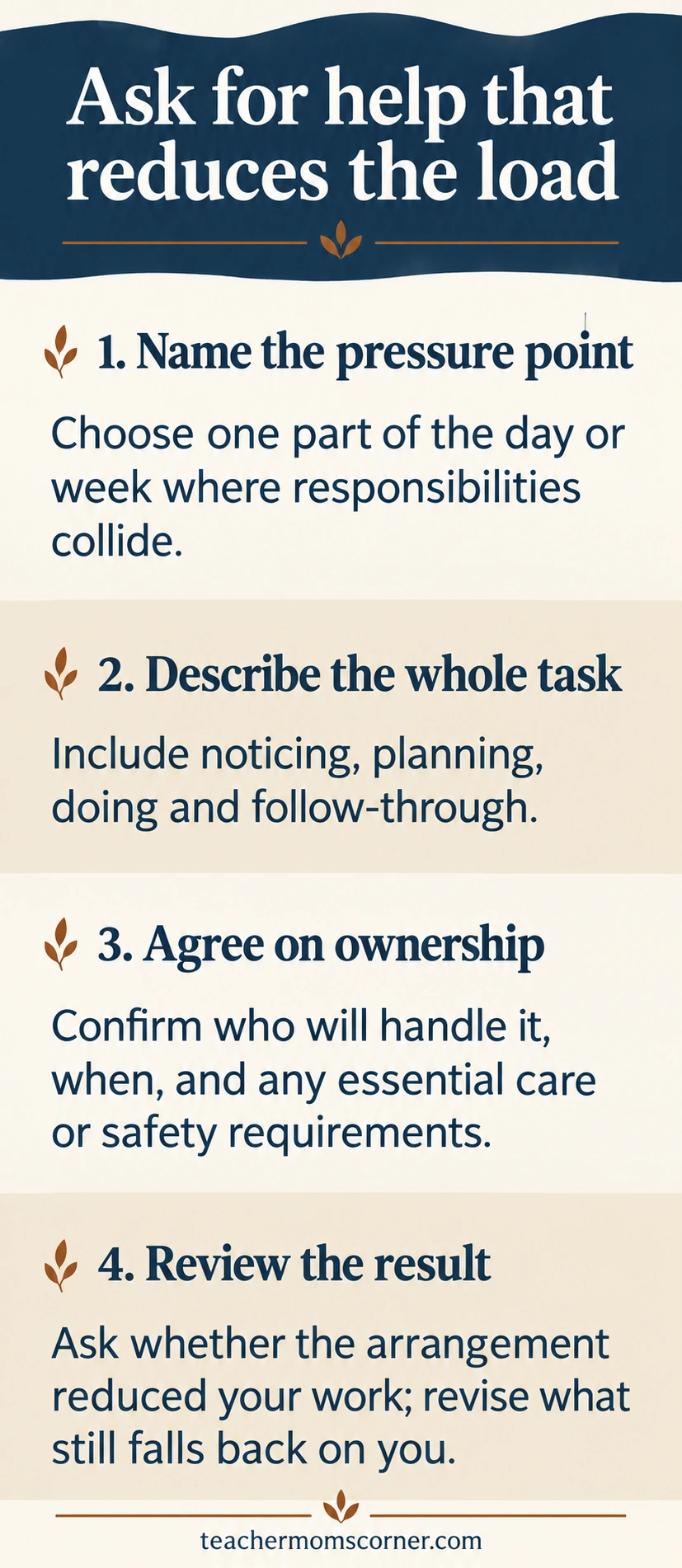
Read the guide as text
- Name the pressure point. Choose one part of the day or week where responsibilities collide.
- Describe the whole task. Include noticing, planning, doing and follow-through.
- Agree on ownership. Confirm who will handle it, when, and any essential care or safety requirements.
- Review the result. Ask whether the arrangement reduced your work; revise what still falls back on you.
Say What You’re Feeling Without Diagnosing Yourself
People use the word "burnout" to talk about different experiences, including exhaustion from paid work, parenting, caregiving, or both. These experiences happen in your daily life, but the terms aren't the same.
The World Health Organization defines burnout in the occupational context, in connection with chronic workplace stress that has not been successfully managed. Broader parenting strain also deserves attention, even when that formal definition does not describe it.
The U.S. Surgeon General's advisory on parental mental health highlights pressures affecting parents and the importance of wider support. Your difficulty may reflect an unsustainable situation, rather than a lack of gratitude or organization.
You don't have to label something before you ask for a change. You could tell someone you're exhausted, forgetting things, and don't have enough time to recover, and this information is useful. If you have symptoms that become severe or affect your everyday functioning, get professional help instead of just thinking that the workload is the only cause.
Figure Out Which Part of Your Day Needs the Most Help
Sometimes it can feel like you're constantly busy but never have enough time to get everything done. Instead of arguing with your partner about who does more around the house, try looking at which part of your day causes the most stress. Maybe it's getting everyone ready for school and work in the morning, preparing dinner after a long day, or spending your entire weekend catching up on errands and household responsibilities.
Think about everything that happens during that time, including the little things you might not normally count as work. This could involve driving, answering messages, making decisions, preparing things for the next day, or dealing with unexpected interruptions. Some responsibilities have to be handled at certain times, while others might be able to wait or be moved to another part of the day.
Think about Rachel's busiest time, being between 5:30 and 7:30 every evening. She's trying to cook dinner, help her children with homework, answer work messages, and get everything ready for the following morning. By the time she's finished, she's exhausted. The problem isn't that Rachel needs to become more organized. She's simply trying to handle too many responsibilities at the same time.
Instead of expecting herself to get everything done faster, Rachel might talk with her partner about taking over one of those responsibilities. Maybe her partner could handle homework and prepare the children's school bags while she cooks dinner.
The important thing is recognizing when your schedule needs to change instead of assuming that you should be able to do everything yourself. Sometimes sharing or moving even one responsibility can make a stressful part of the day much easier to manage.
Remember That Planning Is Part of the Work Too
When couples talk about dividing household responsibilities, they often focus on the chores they can actually see, such as cooking, cleaning, or doing laundry. But there's also a lot of planning and remembering that goes into keeping a household running smoothly.
Doing the laundry doesn't just mean putting clothes in the washing machine. Someone also has to notice when clothes need washing, sort everything, move the clothes to the dryer, fold them, put them away, and make sure there's enough detergent. If you have children, you might also need to remember that they need clean clothes or uniforms for school the next morning.
When one person is responsible for remembering and organizing everything, they can still feel overwhelmed even if their partner helps with certain chores. There's a difference between helping someone complete a task and taking full responsibility for making sure it gets done.
One thing that might help is making a short list of responsibilities that you're constantly thinking about. This could include scheduling appointments, signing school forms, planning meals, arranging childcare, or remembering important family events. You don't need to write down every little thing you do, but identifying a few responsibilities that create the most stress can help you figure out where you need more support.
Remember that sharing household responsibilities isn't just about making sure both people are physically doing something. It's also about sharing the planning, remembering, and organizing that happens behind the scenes. When both people take responsibility for keeping everyday life running, it can help prevent one partner from feeling that everything depends on them.
Asking for Results
A good support request shows the task, the owner, the time frame, and the results. It also leaves room to discuss constraints. You can ask something like, "Can you do dinner on Tuesdays and Thursdays for the next 2 weeks, including what is being cooked, the shopping, and the cleanup?" or you could say, "Can you handle school pickups on Wednesday through the end of the month?"
Ask the person what they can do, and don't just let them say, "Of course," without making a real agreement. Agree on the essential standards, especially where safety, medication instructions, allergies and school requirements are involved. For other details, allow differences. If dinner has to match your method, then giving it to someone else without supervision might not work for you.

Having a Safe Conversation About Responsibilities
If you have a partner who's safe and cooperative, or another adult who helps with responsibilities, pick a time outside the busiest moment to talk. Explain what the problem is and what kind of change would help you, with concrete examples of the responsibilities that need to change.
You might say something like, "Our current arrangement causes me to have to deal with everything most of the week, and I need us to divide the responsibilities and not wait until I ask you every time."
Look at whether you're able to do that, as well as your paid hours. Commutes, disabilities, shifts, and other demands can affect what is workable. Fairness might not look the same each day, but it should allow both people to have their needs met and their rest.
Set a time to look at the new arrangements. If it fails, ask what didn't work and why. Do not assume that you can solve every problem by going back to the task when the person is already overloaded and overwhelmed.
Be Clear About What You Can Handle at Work
Sometimes work can become overwhelming, especially when you're expected to take on more responsibilities without having enough time to finish everything. If you're struggling to keep up, it's important to communicate with your manager about what you can realistically accomplish instead of continuing to take on more than you can handle.
One way to approach this is by explaining what needs to be done and asking which responsibilities should come first. For example, you might say, "I can finish the report by Thursday, or I can work on the new client's request. Which one would you like me to focus on first?" This gives your manager an opportunity to set priorities instead of expecting you to find time for everything.
If you need to make changes to your work schedule, try explaining exactly what you're asking for. Maybe you need to adjust your hours, work from home on certain days, or change how some responsibilities are handled. Let your manager know what schedule you're suggesting, how you'll stay in contact, and when you could review whether the arrangement is working.
You also don't have to share every personal detail about your family or home life just to explain that you need a schedule adjustment. Sometimes it's enough to discuss your availability and how the proposed changes would affect your work.
But remember that workplace policies and employee rights can vary depending on where you work and your circumstances. If you're considering requesting leave, accommodations, or another important change, check your employer's policies and consider getting professional advice when needed.
The important thing is being honest about what you can manage while still showing that you're committed to doing your job well. Speaking up about your workload doesn't mean you're unwilling to work. It means you're trying to find a realistic way to handle your responsibilities.
Let Friends and Family Know How They Can Help
Sometimes friends and family genuinely want to help when you're feeling overwhelmed, but they aren't always sure what you need. Instead of hoping they'll figure it out on their own, try being specific about what would make your life a little easier.
Instead of telling a family member that you wish they could spend more time with the children, you might ask, "Would you be able to pick up the kids on the first Saturday of each month?" If you're recovering from an illness or going through a stressful time, you could ask someone to bring dinner one evening instead of making a general request for help.
Being clear about what you need gives the other person an opportunity to decide whether it's something they can realistically do. It also helps prevent misunderstandings about what you're expecting.
But remember that just because someone cares about you doesn't mean they'll always be available to help. They might have work, family responsibilities, or other things going on in their own lives. It's important to give them room to say no without making them feel guilty.
For an illustrative example, imagine Melissa struggling to keep up with everything while caring for her children. She asks her friend Amanda whether she could occasionally help with childcare. Amanda explains that her schedule won't allow her to babysit, but she could pick up groceries for Melissa during her weekly shopping trip.
Instead of becoming disappointed that Amanda can't provide the help she originally wanted, Melissa accepts the offer and sends her a short grocery list each week. This arrangement works because Amanda can help without taking on more than she's comfortable handling.
Remember that asking for support doesn't mean expecting other people to put their own responsibilities aside. Sometimes even a small favor can make a difference, especially when it's something that works for both people.
The goal is to communicate what you need, respect what others are able to offer, and find ways to support each other without creating more stress or unrealistic expectations.
Get the Rest You Need
A free hour can disappear when you have tasks you've been putting off. If recovery is part of your support, just say so. You might say that you need Saturday mornings off and for another agreed adult to handle routine questions and decisions during that time, unless there's a real emergency. Say what the arrangement includes, especially if another adult is caring for things like your children.
Rest doesn't have to look big and impressive. It might just be sleeping in, having a quiet conversation, or reading a book. You don't have to use every break for exercise, self-improvement, or activities that create evidence that you're balanced.
If you find it hard to stop working, start with a shorter period and pay attention to what interrupts it. The problem might just be a habit, unclear responsibilities, or someone who's always asking you to coordinate everything. Each of these needs a different response.
Figuring Out a New Solution
Sometimes good support happens when you decide that something won't be done or that it will be easier to do. This can help when paid assistance isn't affordable.
Look at the tasks that are optional, ones that are too frequent, and ones that don't work with your family's needs. Having a simpler meal idea, fewer extracurricular activities, or pausing on having people over can help reduce the pressure.
Health, safety, care, and obligations are real. You can lower the standards, but you cannot ignore your children's needs or stop your prescribed care. This means you see the difference between what's important and expectations that can be changed.
Find out who benefits from these changes and what happens if you reduce some of the busyness. This answer might show a real need, preference, or tradition that doesn't fit your life. You can preserve what matters without saying that every familiar routine has to be the same.
Find Reliable Support When You're Raising Children Alone
Being a single parent can be overwhelming, especially when you're responsible for handling everything on your own. Between working, taking care of your children, managing the household, and keeping up with everyday responsibilities, there might not be much time left for yourself. While people often suggest dividing responsibilities with a partner, that advice doesn't really help when you don't have another adult at home to share the work.
Instead, try looking for dependable support that could make your everyday life a little easier. This might involve checking into school programs, community resources, childcare assistance, or local parenting groups. You could also ask your employer whether there are flexible scheduling options that might help you balance work and family responsibilities. Just remember that programs and eligibility requirements can vary, so it's important to find out what's actually available before making plans around them.
Sometimes other parents can also become a helpful part of your support system. For example, you might arrange to take turns helping with school pickups or childcare. But it's important to make sure that anyone caring for your children is someone you know and trust. Talk about schedules, responsibilities, emergency contacts, and what will happen if someone needs to cancel. Just because someone is also a parent doesn't automatically mean they're the right person to care for your child.
It's also okay to recognize when you have too much on your plate and need to cut back on certain commitments. Maybe that means fewer activities during the week, simpler meals, or changing a routine that has become difficult to manage. Making these adjustments doesn't mean you're doing less for your family. It means you're being realistic about what you can handle with the time and resources you have.
Remember that being a single parent doesn't mean you should have to do everything without help. Finding reliable support and creating routines that work for your family can make everyday responsibilities more manageable.
Make Sure Getting Help Actually Makes Things Easier
Sometimes asking someone for help sounds like the perfect solution, but you might discover that you're still doing most of the work. Maybe your partner agrees to handle a responsibility, but you're still reminding them, gathering everything they need, checking whether the task was finished, and fixing problems afterward. When this happens, the responsibility might not have really been taken off your shoulders.
After trying a new arrangement for a week or so, think about whether it actually made your life easier. Did you have more time to focus on other things, or were you still responsible for managing every little detail? There's nothing wrong with explaining how to do an unfamiliar task at first, but you shouldn't have to provide constant instructions forever.
One thing that might help is keeping important information in one place. For example, you could use a shared calendar for appointments, school activities, and other responsibilities. This allows the person handling a task to find the information they need without constantly asking you for reminders. It's also important to decide who will keep that information updated.
If you notice that a responsibility keeps falling back on you, try having an honest conversation about what's happening. You might say, "I thought we agreed that you were going to handle this, but I'm still doing most of the planning and reminding. What can we change so that you can take care of it?" Sometimes the problem involves needing clearer expectations, learning how to complete the task, or having access to the right resources.
But remember that there's a difference between someone who needs help learning a responsibility and someone who uses threats, intimidation, or financial control when you ask for support. If you're afraid to discuss household responsibilities because of how your partner might react, the situation is more serious than a disagreement about chores. Getting private support from someone who understands abusive relationships might be a safer first step.
The important thing is making sure that sharing responsibilities actually reduces your workload. Getting help shouldn't mean that you're still responsible for organizing and supervising everything. When someone agrees to take on a task, they should also be willing to handle the planning and follow-through that comes with it.
Getting Care for Symptoms
Exhaustion, sleep disruption, irritability, low mood, anxiety, and difficulty concentrating can have different causes. Reducing the workload may help, while concerning symptoms still deserve appropriate professional care.
When you speak with a healthcare professional, explain the symptoms and how they affect your day. Describe when symptoms began, how often they occur, and how they affect daily life.
If you feel that you're unable to keep yourself or your children safe, get help through a local emergency or crisis service and find a person you can trust to help you right away. You don't have to wait for a planned appointment when a crisis is happening.
Getting care is something that can work with the conditions around you. You can need treatment, rest, help, and a lighter workload all at the same time.
Getting Support
Pick one pressure point and one complete task to change, simplify, postpone, or share with others. Agree on who is going to do what and when you will look at it. Write a note about success and how you can make it happen, such as having less evening interruptions, taking a break, or saying no. Don’t track every minute unless it’s useful.
At the review, ask what got better, what still falls through, and what can be changed. Keep your changes that work. Having a small arrangement that is reliable might be more valuable than dramatic promises that last two days.
Working mom burnout needs a response that doesn’t just ask you to cope better, but that changes the work, responsibilities, and the availability to allow you to get the help you need and supports your changes.
Build a specific request for support
Choose a pressure point and a period for a request that includes the planning as well as the task.
Adapt the request to each person’s capacity and the actual care or safety requirements. Getting help can include changing the workload itself.
Use the questions and examples in the article above; the draft builder needs JavaScript.
15 questions readers ask
1. Do I need a diagnosis before asking for help?
No. You can describe exhaustion, competing responsibilities or lack of recovery time without diagnosing yourself. Symptoms that concern you can also be discussed with a healthcare professional.
2. Does WHO use burnout to mean all parenting stress?
No. WHO’s formal burnout description concerns the occupational context. Parenting and caregiving strain still deserve support even when that definition does not apply.
3. What is a useful first request?
Choose a recurring pressure point and ask for a complete responsibility to change hands. For example, ask someone to own dinner on agreed evenings, including planning and cleanup.
4. What counts as the mental load?
It includes noticing what is needed, planning, remembering, arranging and following up. A task may still be yours in practice if you must constantly supervise it.
5. Does a fair division mean identical chores?
Not necessarily. Consider available time, paid work, health, disability, shifts and care demands. Look at whether both people’s needs and rest are treated seriously.
6. How can I avoid becoming the household supervisor?
Agree on task ownership, essential standards and where information can be found. Allow different workable methods for nonessential details, and review whether reminders still fall to you.
7. What if my partner says “just ask me”?
Explain which responsibilities you need them to notice and manage independently. Make one concrete agreement and review the follow-through rather than relying only on a general offer.
8. What can I ask my manager?
Ask which tasks take priority when the workload exceeds available time. If you need a schedule change, describe the proposal and check policies, eligibility and practical limits.
9. Must I tell work every personal detail?
You can limit what you share while providing information required for a particular request. Ask about policies and seek suitable advice for leave or accommodation questions.
10. What if I cannot afford paid help?
Consider whether optional commitments can be reduced and which school, community or family supports are actually available. Check eligibility and reliability before depending on a service.
11. How can a single parent use this advice?
Focus on dependable support beyond a partner: trusted adults, school programs, suitable childcare and workable employment arrangements. Shared-care plans need clear responsibilities and a backup.
12. Can I ask friends without pressuring them?
Make a specific request and leave room for an honest answer. Someone who cannot provide childcare may be able to help with a different task; an offer needs to work for both people.
13. Should every break be used productively?
No. Rest can simply be rest. Clarify who covers routine care during that period so that you are not still managing the task from a distance.
14. What if asking for help leads to threats or control?
That is more serious than a disagreement about chores. Seek private support through a safe channel rather than relying on a better request to prevent someone’s abusive response.
15. When does exhaustion need professional attention?
Seek advice when symptoms are severe, persistent or affect daily functioning. If you cannot keep yourself or your children safe, seek urgent local crisis or emergency help and support from a trusted person.