

If you describe yourself as an empath, you may mean that you notice emotions easily, care deeply or understand your sensitivity in a spiritual way. That description does not make you responsible for someone else’s cruelty. A harmful relationship is not evidence that you attracted mistreatment or failed to protect your energy.
Instead of asking what is wrong with your kindness, look at what is happening between you and the other person. Can you disagree, ask for space and have needs of your own? Those everyday experiences offer a clearer starting point for deciding what support or change you want.
On this page

1. Separate empathy from responsibility for another person’s actions
You can understand that someone feels lonely, stressed or disappointed without agreeing to what they ask. Their feelings can matter alongside your sleep, privacy, time and ability to choose.
For example, listening to a difficult day does not mean you must accept insults during the conversation. Caring about someone’s finances does not require lending money you need for rent. Knowing their history does not make you responsible for repairing every consequence of their choices.
The National Domestic Violence Hotline explains that responsibility for abusive actions belongs to the person causing harm. Someone else’s mistreatment is not a measure of how empathetic, patient or spiritually aware you are.
It is still possible to reflect on what you want to do differently. Asking for help sooner or reconsidering an arrangement can support your choices now. Reflection does not require deciding that you caused what happened.
2. Describe the behaviour before trying to explain the person
“Toxic” can express how distressing a relationship feels, but it does not identify the particular problem. Write or think through a clear example: what happened, whether it has happened before and how it affects you. Keep a private record only if doing so is safe.
- A disagreement: you have different preferences and both can speak or decline.
- An unworkable pattern: one person repeatedly expects last-minute help while your commitments are dismissed.
- A safety concern: saying no leads to threats, intimidation, surveillance or pressure to give up outside support.
These examples call for different responses. A scheduling problem may need an agreement. A pattern of control deserves individual support and attention to safety; a more polished conversation cannot make another person stop it.
You do not have to diagnose narcissism or know someone’s hidden motives before taking a concern seriously. You also do not have to prove that they are a wholly bad person to decide that a particular arrangement is unacceptable.
3. Make room for your own limits when it is safe
If you feel safe having the conversation, start with one specific limit. Name what you can offer and what you cannot: “I can listen for a little while this afternoon. I cannot stay on a call through the night.” There is no requirement to explain every part of your history to justify a practical limit.
A boundary concerns your participation and choices. It does not give you control over another person’s friendships or decisions. Our guide to creating healthy boundaries in relationships offers examples involving time, privacy and shared responsibilities.
Consider the work around a limit too. If you share care of children, a break may need a clear handover and another adult’s agreement. If you work together, a request may need to go through an appropriate workplace channel. Use the responsibilities and options you actually have.
If you fear the response, you do not have to announce a boundary or test how firmly you can hold it. Seek private support before deciding what to say or change.
4. Look for follow-through rather than the perfect explanation
After a safe conversation, consider what happens next. Does the person acknowledge the concern? Can they hear a different preference without punishing you? Does an agreed change happen without you having to manage every step?
An apology can matter, but it does not settle whether an arrangement is now workable. Repeated promises followed by the same conduct give you information too. There is no fixed number of chances you owe someone before you may reconsider a relationship.
You may still feel affection, compassion or uncertainty. Those feelings do not cancel what you have observed. You can miss the good parts and still want distance from a harmful pattern.
5. Keep support and ordinary life within reach
When another person’s needs take up most of your attention, ask what has become harder to maintain: seeing a friend, resting, managing work or making decisions about your own time. Choose one manageable connection or routine you would like to restore.
You might tell a trusted person, “I am finding it hard to decide what I need. Could you listen without pushing me to make a decision today?” You do not need to present a complete account or accept someone else’s preferred solution before asking for support.
If prayer, reflection or another spiritual practice is meaningful to you, it can sit alongside practical help. It does not require you to remain available to someone who frightens you or to interpret mistreatment as a lesson you must endure.
6. Choose a next step with safety in mind
Your next step might be a specific conversation, less contact, individual counselling or practical planning. You do not have to resolve every question about the relationship at once.
If there are threats, stalking, violence or fear of retaliation, consider speaking privately with a local domestic abuse advocate. Shared housing, children, money and access to devices can affect what is workable. The Hotline’s safety-planning resources offer a starting point for considering your circumstances. Use a safer device if you are concerned about monitoring. In immediate danger, contact local emergency services when you can do so safely.
Kindness can remain part of who you are. You can also have preferences, limits and support. The question to carry forward is what you need and what is happening, rather than whether you have been caring enough to deserve respectful treatment.
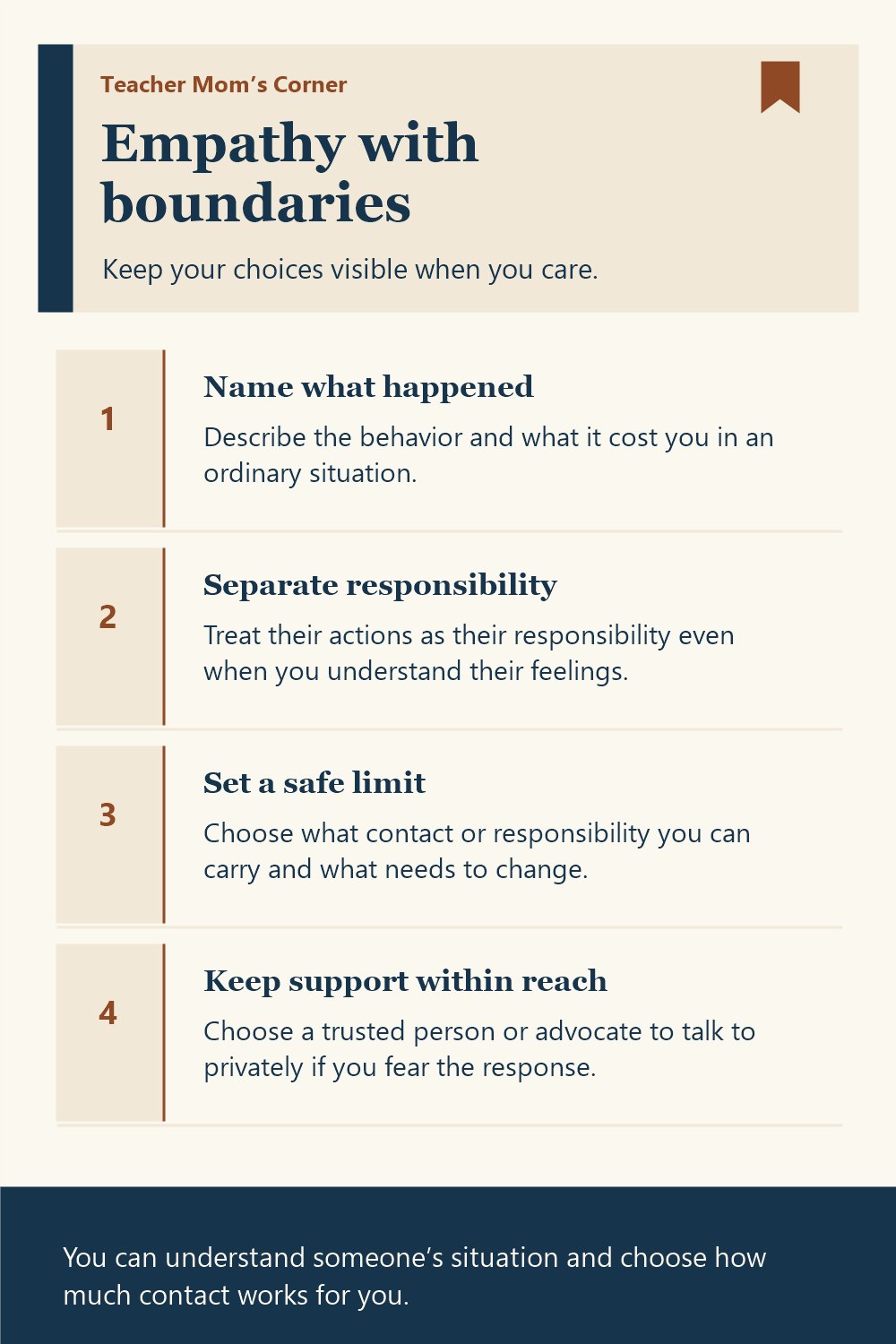
Read the infographic in text
Empathy with boundaries
Keep your choices visible when you care.
- Name what happened Describe the behavior and what it cost you in an ordinary situation.
- Separate responsibility Treat their actions as their responsibility even when you understand their feelings.
- Set a safe limit Choose what contact or responsibility you can carry and what needs to change.
- Keep support within reach Choose a trusted person or advocate to talk to privately if you fear the response.
You can understand someone’s situation and choose how much contact works for you.