

Wondering whether someone is right for you can raise questions about affection, faith, family and the future. You do not need a perfect partner or a mysterious sign to consider those questions. Look at how the relationship works in everyday life and whether it has room for both people’s needs.
Strong feelings can coexist with an unsuitable arrangement. You may care about someone and still want a different level of commitment, a safer relationship or a life that fits your values more closely. A decision does not require proof that either person is entirely wrong.
On this page

Look at everyday behaviour
Ask how you feel able to act around this person. Can you disagree, decline affection, ask a question or spend time with friends without being punished? Consider how concerns are handled, not just how the relationship feels during its best moments.
If prayer or faith is part of your life, it may offer comfort and space to reflect. A spiritual interpretation cannot establish someone else’s intentions or guarantee a safe future. Keep room for concrete information and your own judgement alongside your beliefs.
A concern does not become meaningless because you have felt anxious before. At the same time, a strong feeling is not proof of what another person plans. Write down what happened, what you think it means and what you still need to ask.
Compare words with follow-through
Notice whether promises become actions. If someone says they want more time together, do they help make a plan? If they apologise for a hurtful remark, do they take responsibility and change the behaviour? Look for an ongoing pattern rather than demanding flawless performance.
Make a request specific enough to discuss. “Please tell me when our plans need to change” is clearer than “Show me you care.” You can consider the response and whether the agreement is workable for both of you.
Disappointment does not automatically mean the relationship must end. It gives you something to address. Repeated dismissiveness or broken agreements may also tell you that the arrangement available now differs from the one you want.
Discuss what each of you wants
Talk about commitment, exclusivity, living arrangements, children, faith or other priorities that affect your shared future. You do not have to ask everything at once, but avoid relying on an imagined agreement. “What kind of relationship do you want?” leaves room for an honest answer.
Taking things slowly can be a mutual choice. It becomes a problem if one person keeps accepting uncertainty that does not work for them, hoping patience will change the other’s mind. You can state what you want without imposing a deadline intended to force a commitment.
Attention may change as work, parenting or other responsibilities shift. Less frequent contact does not prove someone has stopped caring. Discuss what connection is possible and whether it meets your needs; constant access is not a measure of love.
Keep your values and responsibilities visible
Separate negotiable preferences from important needs. Different hobbies may be easy to accommodate; incompatible plans about having children may not be. You can consider a compromise without giving up safety, consent, meaningful relationships or a valued part of your identity.
If you are a parent, consider how dating fits the care your children need. Take introductions and changes at a pace suited to their circumstances. Avoid asking children to decide whether someone is right for you or to carry private adult concerns.
A trusted person within your faith community may help you think, provided they respect your choices and safety. Prayer does not oblige you to remain in a harmful situation, and an ending does not prove you failed to listen well enough or that a perfect partner is guaranteed next.
The NHS guidance on relationships encourages personal boundaries and time for your own interests. A relationship can include closeness while allowing each person a life beyond the couple.
Choose a next step with support
You might raise one concern, agree on a practical change, take time to think or decide the relationship no longer fits. Notice what would help you make that choice freely: information, a private conversation with someone trustworthy or practical help with housing or childcare.
If there are threats, coercion, monitoring or fear of a reaction, seek private support before treating the situation as an ordinary communication problem. You do not need to wait for physical harm or organise a final conversation alone.
Try asking: “What do I know about this relationship today, and what am I hoping will change?” Both questions matter. Your choice can rest on your needs, values and available support rather than certainty about whether someone is “the one.”
Read the infographic in text
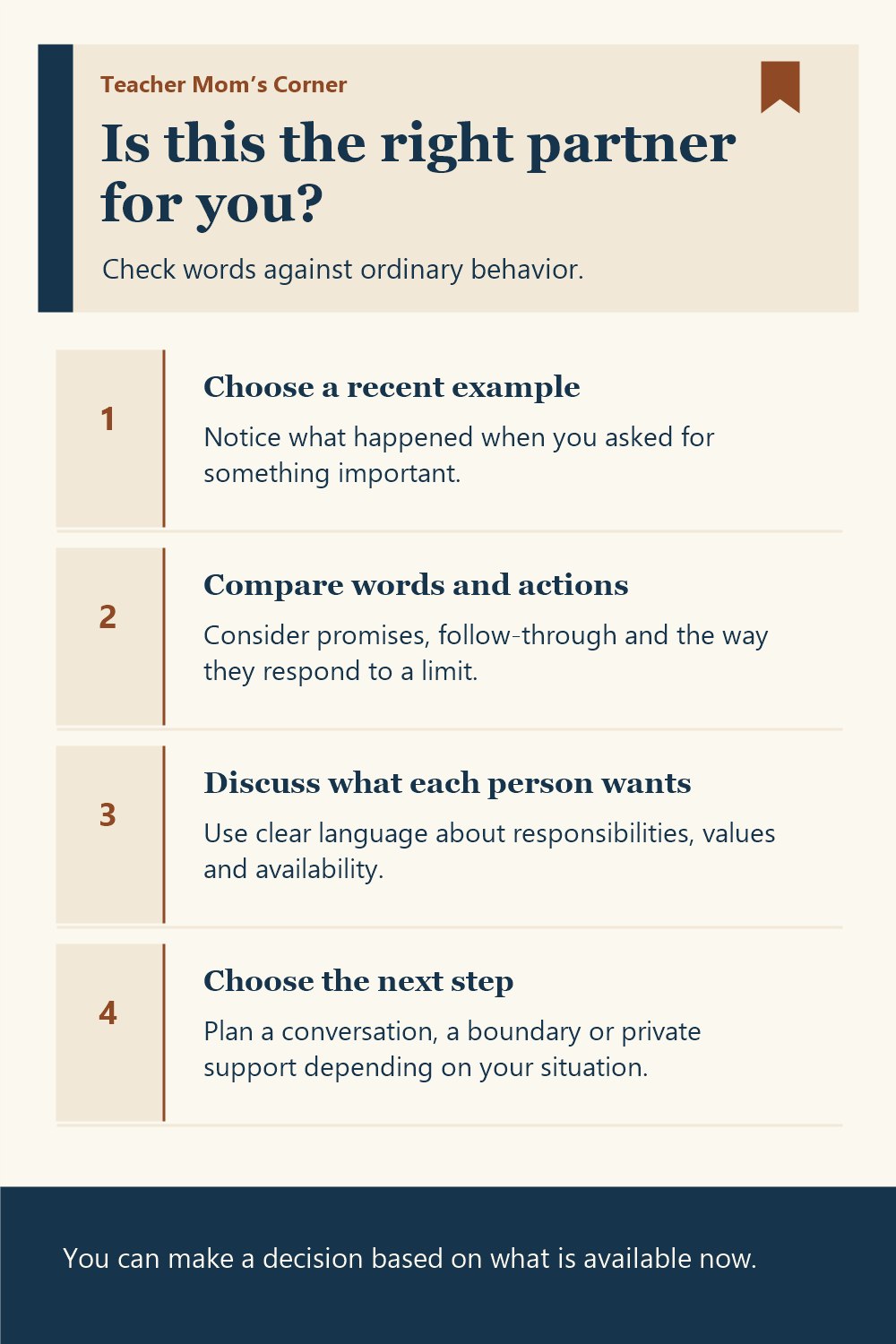
Is this the right partner for you?
Check words against ordinary behavior.
- Choose a recent example Notice what happened when you asked for something important.
- Compare words and actions Consider promises, follow-through and the way they respond to a limit.
- Discuss what each person wants Use clear language about responsibilities, values and availability.
- Choose the next step Plan a conversation, a boundary or private support depending on your situation.
You can make a decision based on what is available now.