

Showing care does not always need a surprise or a free evening. It may mean listening without rushing, taking responsibility for an agreed task or making room for a partner to rest. The most useful gesture depends on the person and the day you are both having.
A quiet period in a relationship does not automatically mean anyone has stopped caring. Look at whether you feel considered, can discuss concerns and have room for your own needs. Small acts matter most when they sit alongside respect and shared effort.
On this page

1. Ask what would help today
Try a specific question: “Would you like me to listen, help with the task or give you some quiet time?” The answer may be different from what you would want in the same situation.
If your partner wants to talk, check that you have the attention and time to listen. You might put a device aside, ask a clarifying question or say when you can return to a longer conversation. A short, honest check-in can be more workable than distracted agreement.
The NHS’s guidance on healthy relationships and wellbeing suggests checking that you understand what someone is saying. You can reflect back the main point without assuming you already know the solution.
2. Share the ordinary work
Practical care includes the planning behind a job. If you agree to handle a school form, appointment or grocery shop, clarify what that includes and follow it through. Requiring repeated instructions can leave the other person carrying the coordination as well as their own tasks.
Look at the whole week rather than one impressive favour. Paid work, caregiving, disability, sleep and other demands affect capacity. Fairness may require different arrangements at different times; it still needs to be discussed by both people.
If you cannot do what you offered, communicate early and help find a workable alternative. Avoid making promises simply to end a conversation. Reliability in ordinary tasks is a practical way to show that someone’s time matters.
3. Notice what matters to your partner
Ask about an interest, a goal or an event they mentioned earlier. Remembering an important meeting or making space for a hobby can show attention without turning their life into a project you manage.
Celebrate good news in a way they enjoy. Someone may want a lively conversation, a meal together or a quiet acknowledgement. Avoid assuming that public praise, an expensive gift or a social-media post will always be welcome.
Care also includes how you respond to disappointment. You can say, “That sounds difficult; what would help?” without insisting they find the positive side immediately. Making room for frustration is compatible with being a supportive partner.
4. Make time without turning it into a demand
Choose a shared activity that fits your actual resources. A short walk, cooking together or sitting down after the children are asleep may be possible when a long outing is not. Either person can suggest an alternative or decline.
Support for a goal can be specific and limited: “I can cover the evening routine on Tuesday so you can attend the class.” Ask before giving advice, tracking progress or taking over. Your partner keeps ownership of their goal, and you keep the right to state your own capacity.
Affection should also be welcome. Ask whether a hug, touch or company would feel good rather than treating it as something a partner owes you. Rest and time alone can be needs you make room for together.
5. Review whether care goes both ways
Ask whether your everyday arrangements leave both people feeling considered. Can you each request help? Is one person usually expected to anticipate everything? Are gratitude and follow-through present alongside kind words?
Appreciation can be concrete: “Thank you for arranging the appointment and checking the transport.” It does not have to become a running score. At the same time, noticing a persistent imbalance is useful; gratitude should not make unfair expectations impossible to discuss.
If a request becomes an argument, focus on the specific task and the change you need. You do not have to stay cheerful throughout every difficult conversation. Repeated contempt, threats or control calls for attention to safety and support, rather than more gestures from the person being hurt.
Pick one useful action for the coming week and one conversation about what needs to be shared more fairly. You can offer care while still making room for your own rest, interests and limits.
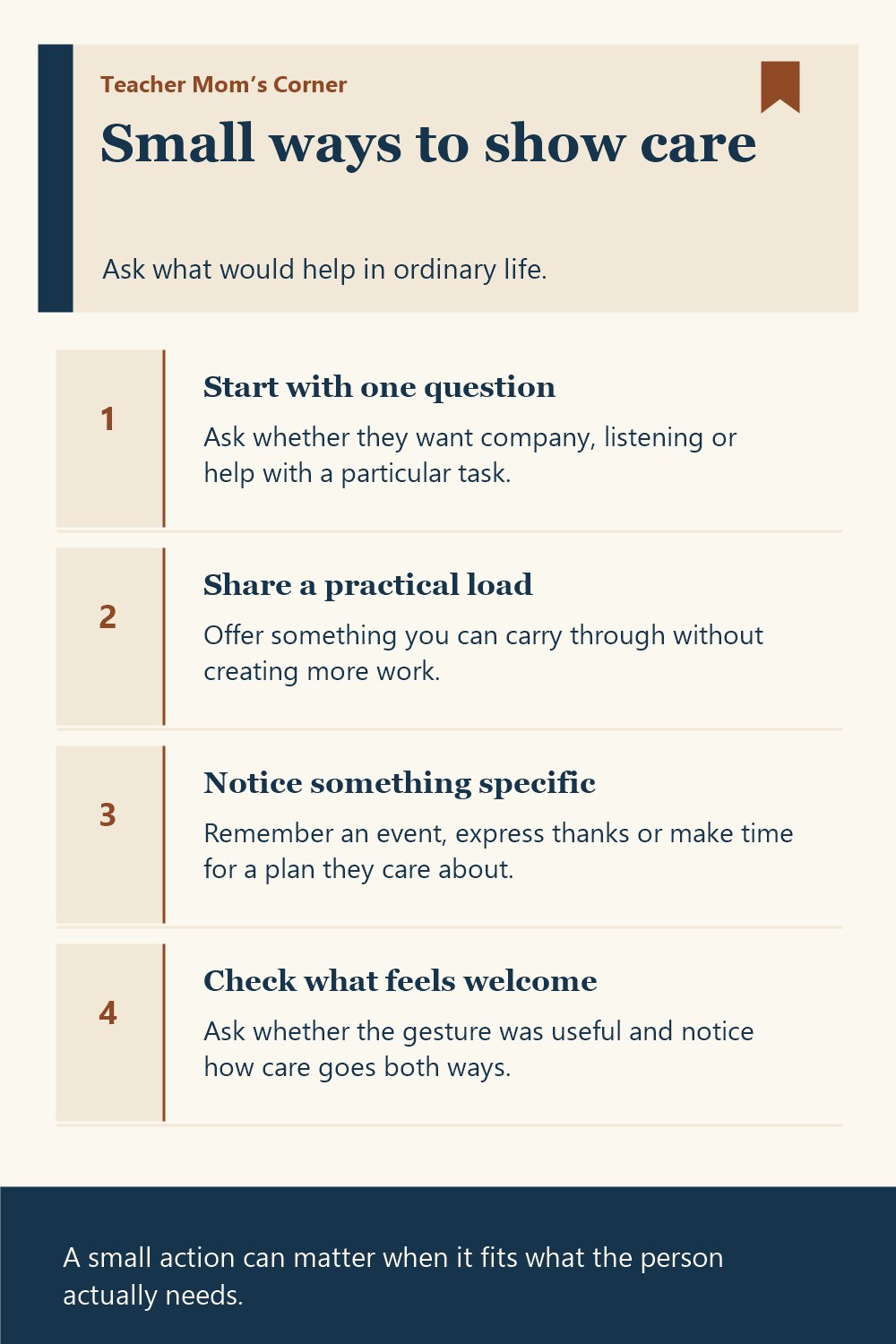
Read the infographic in text
Small ways to show care
Ask what would help in ordinary life.
- Start with one question Ask whether they want company, listening or help with a particular task.
- Share a practical load Offer something you can carry through without creating more work.
- Notice something specific Remember an event, express thanks or make time for a plan they care about.
- Check what feels welcome Ask whether the gesture was useful and notice how care goes both ways.
A small action can matter when it fits what the person actually needs.