

Love does not have one required feeling. A relationship may include warmth, attraction, comfort, uncertainty or frustration, sometimes within the same day. Feeling excited does not prove that a relationship is right for you, and a quiet period does not automatically mean love has disappeared.
It can be more useful to consider how you treat each other and whether the relationship leaves room for both people’s needs. You do not have to share every hobby or agree about every meal. You also do not have to dismiss an important difference as a trivial complaint.
On this page

Separate preferences from important needs
Different tastes are often manageable when each person has room to enjoy their own interests. One partner might like camping while the other prefers a comfortable place to stay. The useful question is whether they can plan fairly, rather than whether love should make their preferences identical.
Some differences affect much more than an evening out. Decisions about children, spending, where to live or how responsibilities are shared may shape daily life. Name the actual issue before telling yourself that you are being too demanding.
Try dividing a concern into the preference and its effect. “I do not enjoy that hobby” differs from “Your plans leave me doing all the childcare every weekend.” The second concern needs a conversation about time and responsibility, not simply more tolerance for a different interest.
You can have a reasonable need that another person cannot meet. Recognising that mismatch is different from declaring either of you defective.
Look for kindness in ordinary moments
Kindness may look like taking a concern seriously, checking whether help is wanted or keeping an agreement when it is inconvenient. It also includes how someone responds when you say no or make a mistake.
Affection and gifts can be welcome, but they do not cancel repeated insults, pressure or unfair expectations. Look at the overall pattern rather than asking whether one generous act proves that everything is fine.
Consider your own contribution too. Can you make a clear request, acknowledge an impact and accept a refusal without punishment? Caring for a relationship is shared work, although responsibility for harmful behaviour belongs to the person choosing it.
Kindness does not require being endlessly available. A considerate answer can still be, “I cannot do that tonight, but I can help tomorrow.”
Share honestly without giving up privacy
Being able to discuss a worry can make closeness feel more possible. You might say that you need reassurance, that a plan feels overwhelming or that you do not yet know what you want. You can choose a manageable time and share only what you are comfortable sharing.
Vulnerability is not an obligation to reveal every memory, hand over passwords or accept unwanted touch. A partner can respect your privacy while still asking for the information needed to make shared decisions.
Notice what happens after you disclose something personal. Is it handled with care, or later used to embarrass, threaten or control you? If openness has consequences you fear, seek support rather than pushing yourself to reveal more.
Our article on keeping your sense of self in a relationship explores time, independence and boundaries alongside closeness.
Make understanding practical
You do not need someone who can read your mind. Understanding can grow through questions, listening and checking what a request means. “Would you like me to listen or help with a plan?” may be more useful than assuming there is one correct response.
When a recurring difficulty comes up, discuss an arrangement you can try. You might share an evening task differently, agree on how to change plans or make room for separate interests. Keep the agreement clear enough that both people know what they are taking on.
Repair also matters. An apology can name the behaviour and its effect, followed by a realistic change. If the same problem continues, review the pattern rather than treating the apology as a complete solution.
The NHS guide to healthy relationships offers further ideas about communication, boundaries and support.
Review what the relationship makes possible
Ask whether you can express a preference, disagree and make ordinary choices without being belittled or frightened. Consider whether responsibilities and care are reasonably shared, and whether agreed changes actually happen.
No relationship can guarantee constant happiness or an unbreakable bond. You can appreciate what is good while deciding that an important need remains unmet. You are also allowed to leave a relationship that does not suit you.
If there are threats, intimidation or coercion, prioritise safety and specialist support. The task is not to become better at accepting harm. Love can matter deeply while your safety, independence and choices continue to matter too.
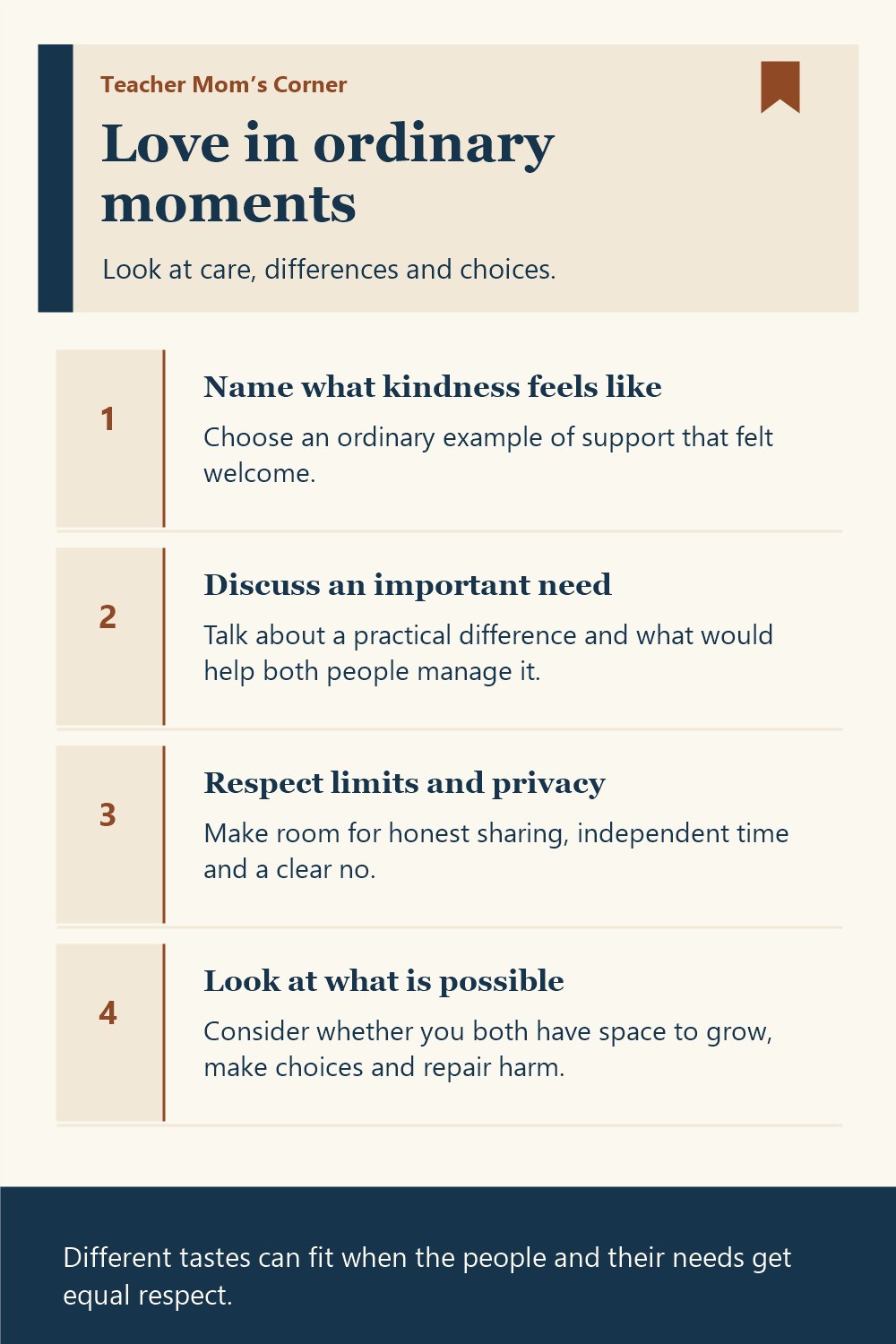
Read the infographic in text
Love in ordinary moments
Look at care, differences and choices.
- Name what kindness feels like Choose an ordinary example of support that felt welcome.
- Discuss an important need Talk about a practical difference and what would help both people manage it.
- Respect limits and privacy Make room for honest sharing, independent time and a clear no.
- Look at what is possible Consider whether you both have space to grow, make choices and repair harm.
Different tastes can fit when the people and their needs get equal respect.