

When something your partner says does not fit what you know, it can be hard to decide whether to ask a question, wait for more information or step back. Suspicion deserves attention, but a change in mood, nervous expression or awkward conversation cannot establish that someone is lying.
These eight steps help you sort out the concern and choose a response. They are not a test you can use to read your partner’s mind. You can ask for honesty and make decisions about your own participation without becoming an investigator or proving every detail.
In this article

Separate the concern from a supposed sign
1. Describe what does not add up
Write down one specific discrepancy: “You said you were working, but later said you spent the afternoon at the cinema.” Keep the statement separate from your interpretation, such as “You must be seeing someone else.” There may be an explanation, or there may be dishonesty. Begin with the part you can describe accurately.
A changed routine or cancelled visit can be disappointing without proving deception. Ask yourself whether your concern is a broken agreement, an unanswered question, a confirmed false statement or uncertainty about the relationship. Each may call for a different conversation.
2. Set aside body-language tests
Looking away, leaning back, hesitating or saying “I didn’t” instead of “I did not” is not a dependable verdict about truthfulness. A review of nonverbal communication and deception describes the weakness and unreliability of behavioural cues. Focus on the information and the agreement at issue, rather than scoring someone’s gaze or posture.
Prepare a clear question
3. Decide what you need to understand
Choose one question you actually need answered. For example: “Were those plans changed after we spoke?” or “Are we still agreeing to be exclusive?” Avoid stacking several accusations together. If the concern involves shared responsibilities, explain the practical effect: “I arranged childcare around the plan we made.”
You do not need access to every private conversation to ask about something that affects your choices. Equally, a request for privacy does not answer a specific question about a broken agreement. Keep those two issues distinct.
4. Choose a workable setting
If it feels safe, ask when you have enough privacy and time to listen. You might say: “There are two different explanations, and I’m confused. Can you help me understand what happened?” You can take a pause if the conversation becomes too heated to follow.
If you fear retaliation, intimidation or violence, a direct confrontation may not be the safest next step. Seek confidential support and consider your circumstances before arranging a discussion. You are not responsible for finding words that make another person behave safely.
Consider the answer and the response
5. Listen for relevant information
Give the answer room, then ask about anything that remains unclear. A correction or forgotten detail is different from a repeatedly changing explanation, but neither should be judged by a rehearsed list of “liar” gestures. You can say, “That explains the time change; I still need to understand why you told me something different.”
6. Notice accountability over time
If someone acknowledges a lie, consider what repair would mean to you. That could involve a clear explanation, a practical change or time apart. An apology does not require you to trust immediately, forgive or stay. Repeated blame-shifting or punishment for reasonable questions also matters, even when every disputed detail cannot be settled.
Keep privacy and support in view
7. Avoid turning uncertainty into surveillance
Secretly accessing accounts, tracking a location or recruiting children to report on a parent can create further harm. Children should not have to carry messages, collect evidence or decide which adult is telling the truth. Talk privately with a trusted adult or suitable professional instead.
Information from a friend can be worth considering, but separate what they directly observed from a rumour or assumption. You can seek support without asking a whole social circle to investigate or take sides.
Choose your next step
8. Decide what you can participate in
Your decision may be another conversation, a revised agreement, support with rebuilding trust or leaving the relationship. You do not need a confession before deciding that an ongoing pattern is unacceptable to you. A boundary could be: “I cannot make shared plans while this information keeps changing.”
Allow yourself time to consider practical needs, including housing, money or parenting arrangements where relevant. The aim is a decision grounded in your needs and the available facts, rather than certainty drawn from a facial expression.
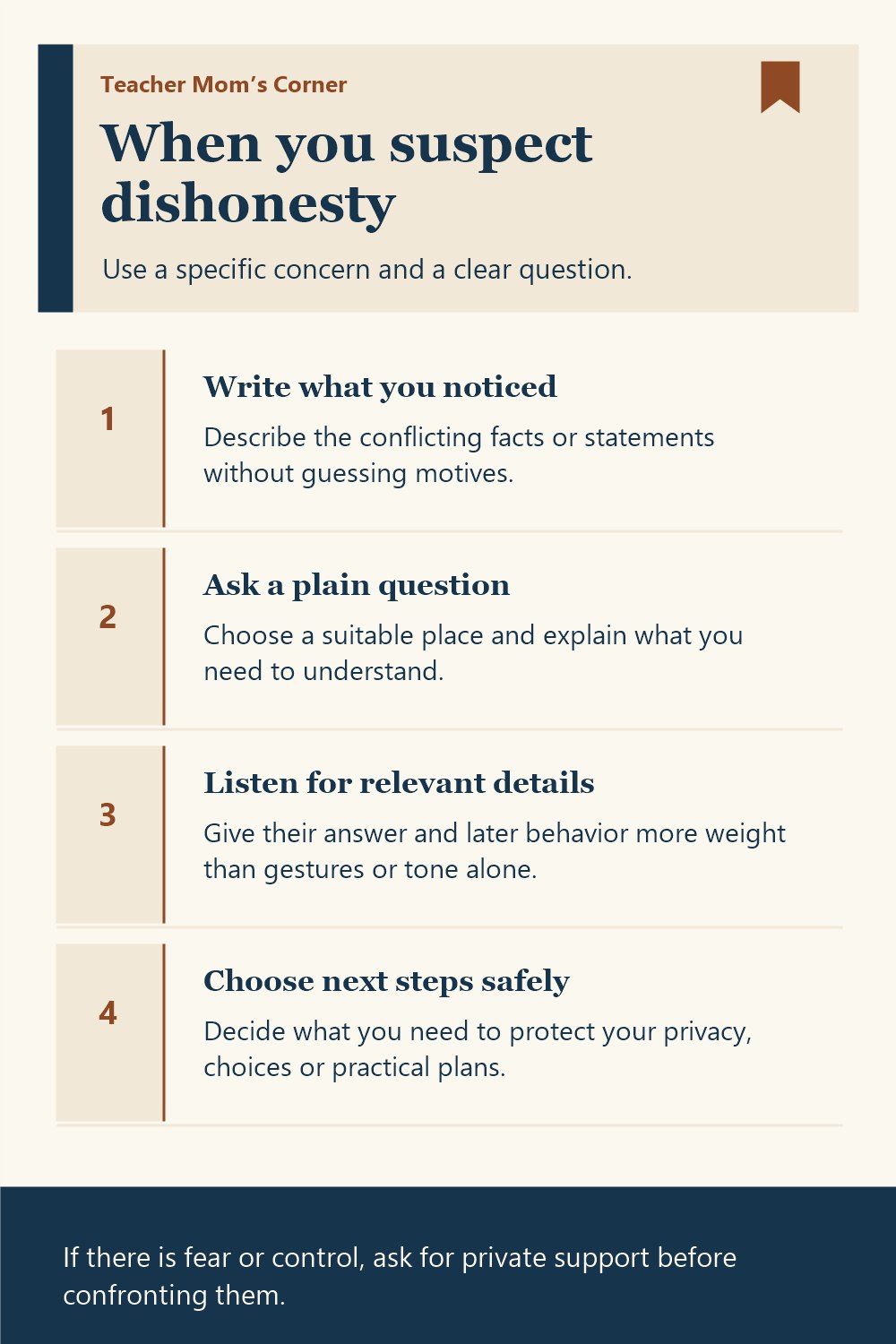
Read the infographic in text
When you suspect dishonesty
Use a specific concern and a clear question.
- Write what you noticed Describe the conflicting facts or statements without guessing motives.
- Ask a plain question Choose a suitable place and explain what you need to understand.
- Listen for relevant details Give their answer and later behavior more weight than gestures or tone alone.
- Choose next steps safely Decide what you need to protect your privacy, choices or practical plans.
If there is fear or control, ask for private support before confronting them.