

A difficult relationship can leave you questioning what you expected from love. You may have imagined that finding the right person would make decisions easy, or that enough effort would always bring you closer.
Realistic expectations leave room for differences, changing circumstances and repair. They also leave room for boundaries and the possibility that a relationship does not work for you. Difficulty alone does not prove a bond is valuable.
On this page

See the person rather than a hoped-for future
You can enjoy someone’s company while still learning whether you want the same relationship. Attraction, a memorable date or an imagined future cannot tell you everything about how you will live together.
Notice ordinary behaviour: how you make plans, handle disappointment, share responsibilities and respond when someone says no. Ask questions about the choices that matter to you, rather than filling in the gaps with what you hope will happen.
If a promise keeps replacing action, describe the pattern plainly. “We have agreed on this three times, but it has not happened” gives you more to work with than deciding you simply need to believe harder.
Both people’s needs belong in the relationship
Wanting affection, companionship or practical support is not selfish. Neither person has to meet every need alone, and neither person’s needs should automatically take priority.
Discuss what you can each offer. A stressful period may call for a temporary change in responsibilities, more outside help or less ambitious plans. Make the arrangement explicit so one person does not quietly absorb an unlimited workload.
You can value the relationship and keep friendships, interests, privacy and time of your own. Consider whether the life you are building has room for both of you.
Hurt calls for accountability, not automatic forgiveness
A mistake can happen in a caring relationship. What follows matters: acknowledging the impact, listening without dismissing it, making amends where possible and changing the behaviour.
You do not have to forgive on demand or immediately restore trust. An apology is not a requirement to continue the relationship, and repeated harm does not become acceptable because nobody is perfect.
Take responsibility for your own words and actions without taking responsibility for everything your partner does. Repair requires participation from the people involved.
Separate ordinary uncertainty from feeling unsafe
Feelings can change with tiredness, stress or a disagreement. You do not have to feel intensely romantic every day to care about someone. A difficult day can be discussed without turning it into a verdict on the whole relationship.
Feeling vulnerable about the future is different from fearing your partner’s reactions. Threats, coercion, humiliation or control are reasons to consider individual safety support, not challenges you must endure to prove your love.
Love alone cannot resolve every problem. You can ask for specific change, seek suitable support or decide to leave. More effort from one person cannot substitute for the other’s willingness, and staying longer does not guarantee improvement.
Choose the care you can offer now
No relationship comes with certainty about how long it will last. That uncertainty can invite a useful conversation about what you value now, without creating pressure to ignore a concern or make a commitment before you are ready.
Choose one manageable action: ask for an uninterrupted conversation, follow through on an agreed task or state a limit you have avoided explaining. Notice whether your partner can respond with comparable care.
You can learn from a relationship without deciding that the pain was necessary. A worthwhile next step should respect your present needs as well as your hopes.
Read the infographic in text
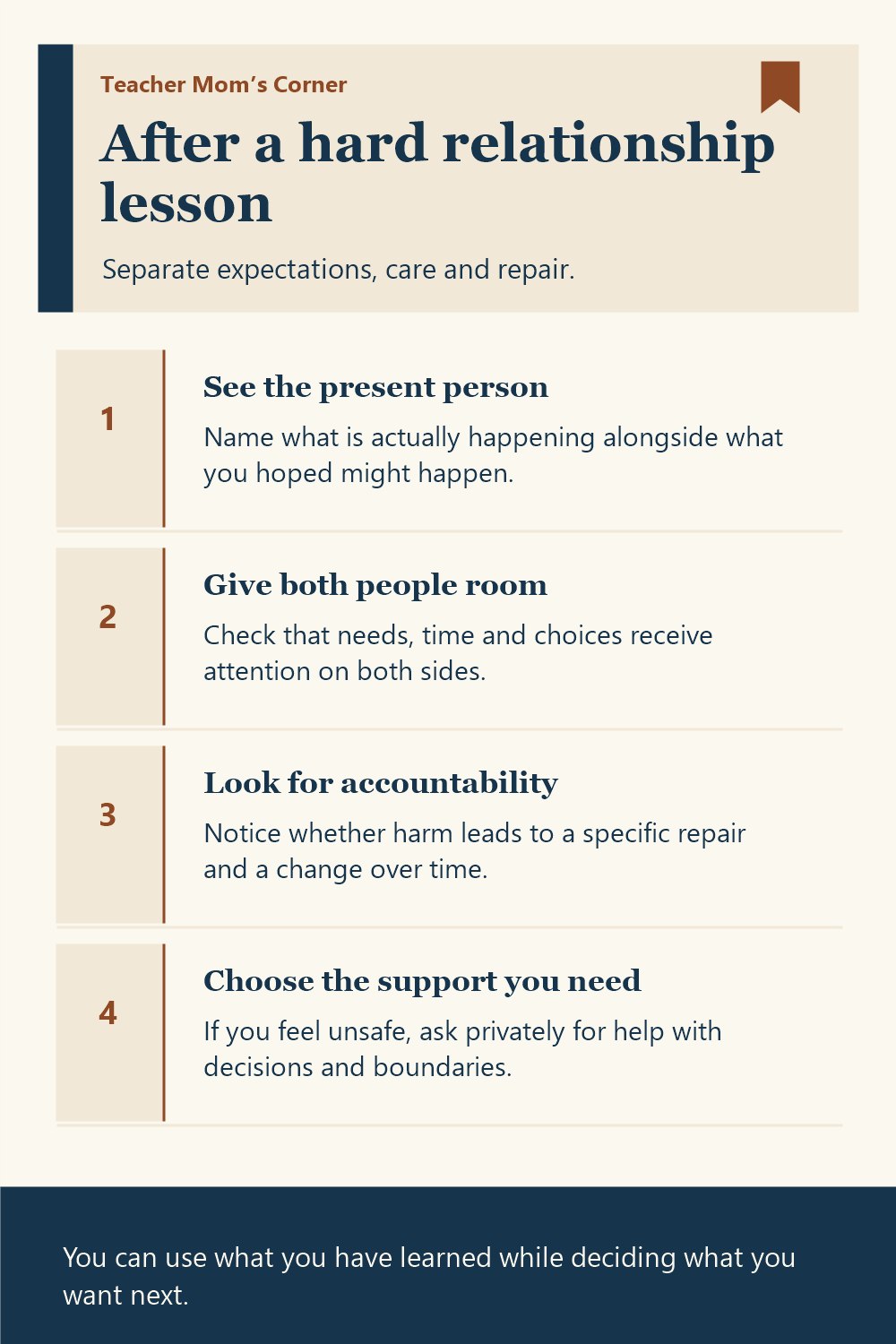
After a hard relationship lesson
Separate expectations, care and repair.
- See the present person Name what is actually happening alongside what you hoped might happen.
- Give both people room Check that needs, time and choices receive attention on both sides.
- Look for accountability Notice whether harm leads to a specific repair and a change over time.
- Choose the support you need If you feel unsafe, ask privately for help with decisions and boundaries.
You can use what you have learned while deciding what you want next.